Revolutionary Nationalism 2.0: The Rise of Indian Revolutionaries & Their Movement

The struggle for India’s independence witnessed various phases and strategies, ranging from moderate petitions to mass movements. However, when the Non-Cooperation Movement was suspended in 1922, young nationalists became frustrated with the non-violent approach. This led to the emergence of Revolutionary Nationalism, which adopted radical methods such as armed resistance, assassinations, and direct action against […]
Civil Disobedience Movement in India – UPSC Notes & Key Insights

The Civil Disobedience Movement was a pivotal phase in India’s struggle for independence, marked by widespread nonviolent resistance against British colonial rule. Initiated by Mahatma Gandhi in 1930, it aimed to attain complete self-rule (Purna Swaraj) by defying unjust laws and regulations imposed by the British government. Download notes of Home Rule League Movement (1916) […]
Non Cooperation Movement & Khilafat Movement: India’s Fight for Freedom
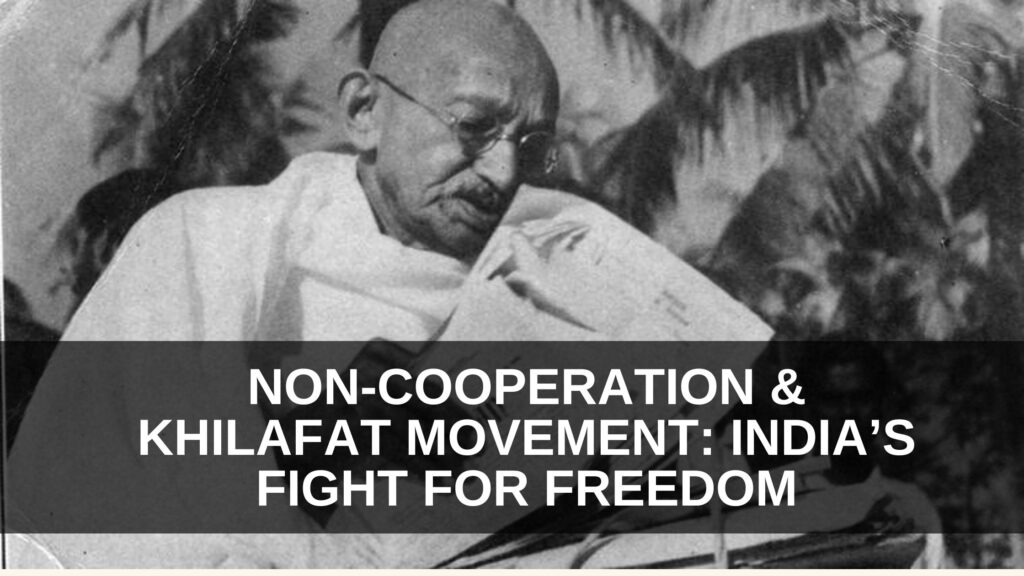
The Non Cooperation Movement, launched by Mahatma Gandhi in 1920, was a crucial part of India’s struggle for independence. It aimed at achieving Swaraj (self-rule) by urging Indians to boycott British institutions, foreign goods, and adopt self-reliance. It was a non-violent mass protest that mobilized millions and laid the foundation for future independence movements. Parallel […]
Emergence of Mahatma Gandhi in the National Movement

The Emergence of Mahatma Gandhi The arrival of Mahatma Gandhi in India marked the beginning of a new phase in the Indian National Movement. Before coming to India in 1915, Gandhi had spent over two decades in South Africa (1893-1915), where he developed his philosophy of non-violence and Satyagraha. These experiences helped him shape the […]
Home Rule League Movement (1916) – Revival of Political Activity

The Indian National Congress (INC) faced a major split in 1907 during the Surat session due to differences between the Moderates and the Extremists. This event led to the exit of the Extremists from Congress, resulting in a period of political inactivity within the party. Download notes of Revolutionary Movement in India Politics After the […]
Revolutionary Movement in India (1907-1917) – Key Events & Leaders | UPSC Notes

The First Phase of the Revolutionary Movement in India (1907-1917) The early 20th century marked a crucial phase in India’s struggle for independence. With the decline of the mass phase of the Swadeshi movement and a lull in political activity, a new form of resistance emerged—revolutionary nationalism. Inspired by the Russian Nihilists and Irish nationalists, […]
Swadeshi Movement in India: History, Leaders & Impact | UPSC Notes

The Swadeshi Movement was one of the most significant economic and political movements in India’s fight against British colonial rule. Launched in 1905 as a response to the Partition of Bengal, it aimed at fostering self-reliance by promoting indigenous industries, boycotting British goods, and encouraging national consciousness among Indians. For UPSC aspirants, understanding the Swadeshi […]
Early Political Activities in India (1858-1905) – Growth of Nationalism

The Revolt of 1857 was the first major attempt by Indians to overthrow British rule. However, it failed due to a lack of unity and modern strategies. This failure highlighted the need for a more organized political movement, driven by new ideologies and modern methods of mobilization. As a result, the second half of the […]
Economic Impact of British Rule in India – UPSC Notes

The British rule in India brought significant changes to the country’s economic structure. Unlike previous rulers who became a part of the Indian economy, the British exploited India’s resources and wealth without integrating into the system. Let’s understand the major economic impact of British rule in India. 1. De-industrialization: Decline of Indian Artisans and Craftsmen […]
Administrative Unification Under British Rule in India | UPSC Notes

The British Empire played a crucial role in bringing administrative and political unification to India. Before British rule, India was fragmented into multiple feudal states, each vying for control. Although historical rulers like Ashoka, Samudragupta, and Akbar attempted to unify the country, their efforts only resulted in nominal political unity. The British, however, established a […]