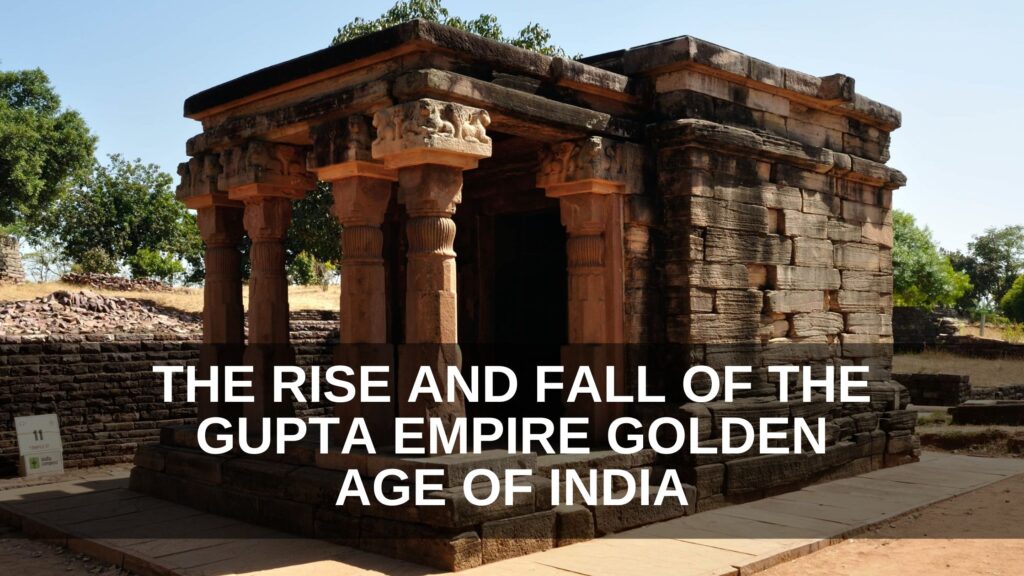
The Gupta Empire stands as one of the most remarkable periods in Indian history, known for its political stability, economic prosperity, and cultural achievements. Before the rise of the Guptas, the Kushanas and the Satavahanas had provided two centuries of stability, but by the mid-3rd century CE, their power waned, leading to a brief period of political fragmentation. This vacuum was soon filled by the Guptas in North India and the Vakatakas in the South.
The Origins of the Gupta Empire
The Guptas initially served as subordinates to the later Kushanas in northwest India. However, in the early 4th century CE, they declared independence and established their dominion. The Gupta dynasty, possibly of Vaishya origin, ruled from their capital at Pataliputra. Their royal emblem, the Garuda, symbolized their sovereignty and divine authority.
Expansion and Consolidation of the Gupta Empire
The Gupta Empire saw significant expansion under its rulers, who played a crucial role in establishing its dominance.
Key Rulers and Their Contributions
1. Sri Gupta (240-280 AD)
- Founder of the Gupta Empire.
- Referred to as Adiraja in Prabhavatigupta’s copper plate inscription.
2. Chandragupta I (319-335 AD)
- Considered the actual founder of the empire.
- Established the Gupta Era (320 AD).
- Strengthened his rule through a strategic marriage to a Lichchavi princess.
- Adopted the title Maharajadhiraja.
3. Samudragupta (335-375 AD)
- Attempted to establish a Pan-India empire.
- Called the “Napoleon of India” by historian V.A. Smith due to his military conquests.
- Defeated the Shakas of western India.
- His achievements are recorded in the Prayag Prashasti inscription by Harisena.
- Conducted the Ashvamedha Yajna, as evidenced by his coinage.
4. Chandragupta II (380-412 AD)
- Secured his throne by eliminating his brother Ramagupta.
- Established Ujjain as his second capital.
- Strengthened ties with the Vakatakas by marrying his daughter Prabhavati to their king, Rudrasena.
- Successfully defeated the Shaka Satraps.
- Chinese traveler Fa-Hien visited India during his reign.
5. Kumaragupta I (415-445 AD)
- Established Nalanda University.
- Faced internal revolts; his reign saw the first Huna incursions.
6. Skandagupta (455-467 AD)
- Defeated the Huns in Mathura, temporarily securing the empire.
- The last Gupta ruler to issue silver coins.
- After Skandagupta, the empire saw weak rulers like Vishnugupta, leading to its eventual decline.

Administration of the Gupta Empire
The Gupta Empire had a well-structured administration with a hierarchy of officials and local governance.
- Divisions of the Empire: 26 Bhuktis (provinces), further divided into Vishayas (districts), Vithis (sub-districts), and Gramas (villages).
- Important Officials:
- Kumaramatyas: High-ranking officials, often of royal blood, managed revenue collection.
- Sandhivigrahika: Minister of peace and war, introduced under Samudragupta.
- Dandapashik: Head of the police department.
- Sarvadhyaksha: Superintendent overseeing various administrative departments.
- Many administrative posts became hereditary, leading to a feudal structure where local elites wielded significant power.
Economic Prosperity: The Golden Age of India
The Gupta period is often referred to as the “Golden Age of India” due to its economic and cultural prosperity.
Coinage and Trade
- The Guptas issued the highest number of gold coins in Indian history.
- However, the decline of silver and copper coins indicates a shift towards a barter economy.
- Major coins included:
- Dinar: Gold coins (deteriorating in quality over time).
- Rupaka: Silver coins (16 Rupaka = 1 Dinar).
- Daler: Copper coins.
- Trade declined due to the weakening of the Silk Route and a fragmented control over trade routes.
Taxation
- Bhaga/Bhoga: Land revenue, payable in cash or kind.
- Vishti: Forced labor, mentioned in inscriptions from Madhya Pradesh and Kathiyawar.
- Tax-free grants were given to Brahmanas, who legitimized Gupta rule by comparing kings to gods.
Growth of Feudalism
- The Gupta army relied on cavalry; chariots became less significant.
- Feudal chiefs (Samantas) provided military support in return for land grants.
- Over time, powerful Samantas set up independent kingdoms, weakening central authority.
Law and Justice
- The Gupta era marked a significant development in legal administration.
- Civil and criminal laws were distinctly defined.
- Legal texts like the Dharmasastras of Manu, Yajnavalkya, Narada, and Katyayana influenced judicial decisions.
- The monarchy’s power was limited by scriptures, in contrast to the Mauryan period, where the king had absolute legal authority.
Decline of the Gupta Empire
Despite their initial successes, the Guptas eventually succumbed to internal and external pressures.
Huna Invasions
- The Hunas, a Central Asian tribe, repeatedly attacked Gupta territories.
- Kumaragupta I faced initial threats; Skandagupta repelled them temporarily.
- By the late 5th century, the Huna chief Toramana controlled large parts of India.
- His son Mihirakula extended their rule, devastating Indian cities and Buddhist monasteries.
Administrative Weaknesses
- Feudal setup: Local chiefs gained autonomy, weakening central control.
- Expansionist policies: Frequent wars drained resources.
- Loss of revenue control: Taxation was delegated to feudal lords, limiting direct revenue.
- Succession crises: Weak successors led to power struggles and fragmentation.
Final Collapse
By the mid-6th century, the Gupta Empire disintegrated into smaller kingdoms. The Maitrakas of Valabhi, the Hunas in Punjab, the Maukharis of Kannauj, and Yashovarman of Malwa emerged as independent rulers. North India remained politically fragmented for several centuries until the rise of the later medieval dynasties.